
Hampshire is home to three of the four native species of Anurans, the order of amphibians commonly know as frogs and toads, and the Isle of Wight to two of the species. Our native frogs and toads are all most active at night, but can be seen or heard calling during the day occasionally as well.
The Common Frog (Rana temporaria) thrives in a variety of habitats, including garden ponds, woodlands, and damp environments. These frogs feed on a wide range of invertebrates, often sitting out in the open at night waiting for worms, slugs or other invertebrates to wander within reach of their long sticky tongue. During winter, they hibernate in places like compost heaps, under rocks, or buried in mud at the bottom of a pond. Although some frogs may stay close to their breeding ponds, most will travel up to 500 metres away outside of the breeding period. Common frogs have a huge range of colours and can be found from pale yellows to almost black. Generally they have moist smooth skin, although females can sometimes have an obvious warty texture which can lead to confusion with toads if you are less comfortable with your identification. They often have a darker patch behind their eyes (sometimes looking like a bandit mask). Individual frogs can sometimes be identified from year to year by the blotch pattern on their backs. Breeding male frogs have a pale blueish/white throat.
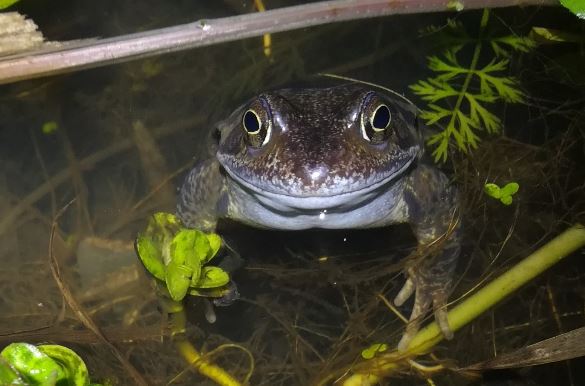
The Common Toad (Bufo bufo) prefers moist, shaded environments such as woodlands, grasslands, and gardens. They feed in a very similar manner, sitting in a spot at night waiting for invertebrates to wander past. Toads can be found in much drier conditions than frogs and can wander much farther from their breeding ponds, and it is not uncommon for them to travel more than1km away. Research in 2004 (Young, Beebee) looked at trends in population declines in common toads and in 2018 a study by Froglife and the University of Zurich concluded that common toads had declined by 68% over the previous 30 years. Toads are generally grey to dark brown in colour, often with darker blotches, with a pale underside, often with a speckled pattern. Common toads have copper coloured eye and also have a ridged gland behind their eyes, which produces a foul tasting mild toxin to deter predators.

The Natterjack Toad (Epidalea calamita) is much rarer and its main strongholds in the UK are on the Norfolk and North West England coastlines. Despite a wider distribution in Hampshire heaths in the past, only a couple of small isolated populations now remain. They require warm, shallow water for breeding and vulnerable to breeding ponds drying out and the terrestrial habitat being lost to scrub and trees. Natterjacks are smaller than common toads, rarely reaching more than 7cm in length. Their colour ranges from a grey green to brown with a pale dorsal stripe and their warty skin often has red blotches on the tips of the warts.
The fourth UK Anuran is the Northern Pool frog (Pelophylax lessonae) which is only found in a small area of Norfolk where it is the focus of a reintroduction project. We do have the non-native Southern Pool Frog (also named Pelophylax lessonae) in Hampshire, see below.
Breeding: All of the frog and toad species have a broadly similar breeding cycle. All three will emerge from hibernation, usually the males emerging first, followed by late emerging males and females. They make their way to their breeding ponds and the males will attempt to clasp on to the back of any females they encounter. Occasionally females may be forced to carry one or more males back to the pond if they clasp on to her before she gets there. Once at the pond, when ready the females will lay their eggs in either clumps (frogs) of strings (toads) and the males will fertilise the eggs as they are laid. Sometimes the females may be seized by a large number of males, which ends up in a mating ball, with the female at the centre and she may drown if the mating ball is under water. The tadpoles develop external gills son after hatching which are covered by a fold of skin after a couple of weeks and take on the appearance of tadpoles as we generally think of them.
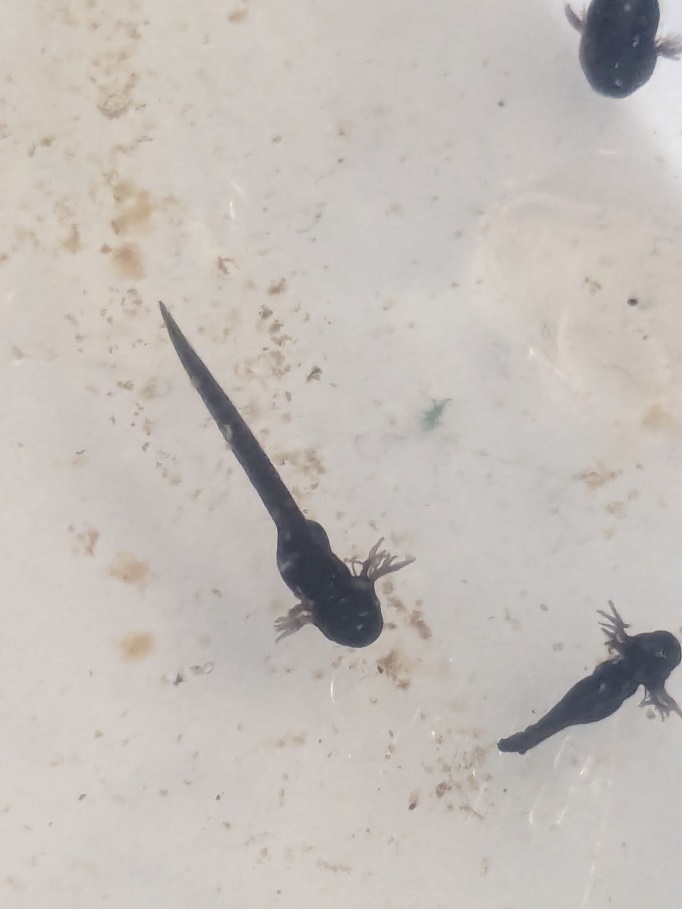
Common frogs have been known to lay spawn in late autumn, especially in Cornwall, but usually they will emerge from hibernation in January and early February and head back to their breeding ponds. They prefer to breed in shallow water bodies, but are also known to use tyre ruts and shallow ditches. Their breeding strategy is to lay large clumps of spawn that can contain around 2000 eggs, which develop very quickly in the shallow water. Despite the large number of eggs laid, only a fraction of the emerging tadpoles will make it to maturity, often much less than 1%.
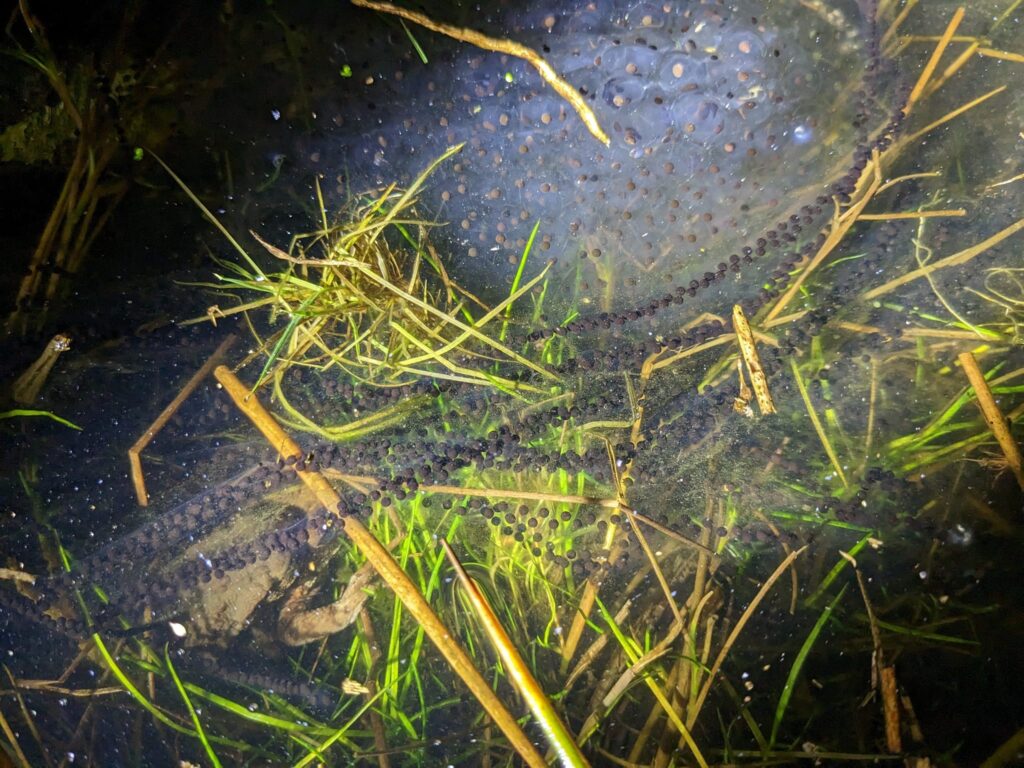
Frog and common toad spawn (above).
Common toads tend to return to the same pond or lake they were spawned in in Mid February to April, laying strings of spawn with around 1,500 eggs in a double row. The tadpoles hatch after about two weeks and as they grow, they develop legs and eventually leave the water as tiny toadlets after 3-4 months usually from June onwards. Although more toad tadpoles survive to their metamorphosis to toadlets due to their unpleasant taste, once they leave the pond they are heavily preyed upon by a wide range of birds and other animals.
Natterjack toads also lay long strings of spawn, with eggs in single rows rather than double rows like the common toad. Natterjacks lay up to 7,500 eggs in a string from April to July, and because of their preference of warm sandy shallow pools, their development is much faster, sometimes within one month if the conditions are right, but this does leave them very vulnerable to their pools drying out.
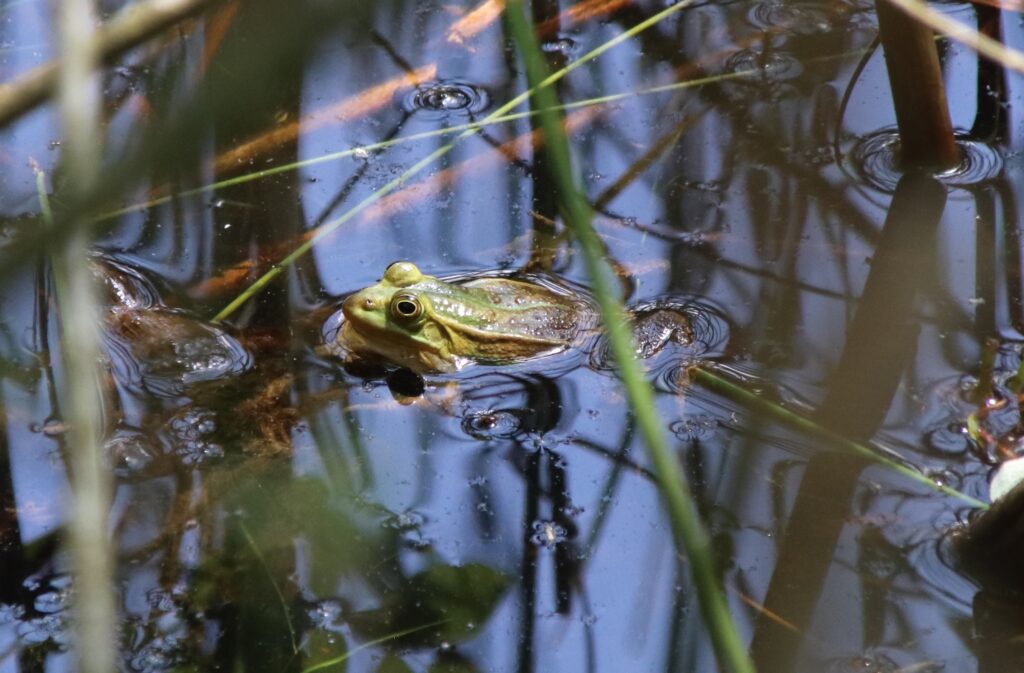
Non-native frogs and toads: Hampshire has four of the water frogs, (Pelophylax species) and the Isle of Wight has a single account of a water frog calling. The Pelophylax group of frogs are called either water frogs or green frogs, but as they can be found a range of colours from yellow to brown they are probably better referred to as water frogs, due to their preference of staying close to water. We make the exception for the HIWARG water frog monitoring project, the Big Green Frog Hunt, purely because it has a better sound to the project’s name. The water frog species we are aware of in our area are Marsh Frog (Pelophlax ridibundus), Edible Frog (Pelophylax kl. esculentus), Southern Pool Frog (Pelophylax lessonae) and Perez’s Frog/Iberian Water Frog (Pelophylax perezi).
Common Midwife Toad (Alytes obstetricans) There are some references from twenty years ago about midwife toads being present in Winchester, but HIWARG has yet to find much more than anecdotal accounts. Watch this space.
Common Tree Frog (Hyla arborea) A breeding population of common tree frog’s were known from the New Forest until 1988, which was when the last sighting was recorded. There is some speculation on whether the tree frogs in this location may have been a relic native population, but there is little evidence either way.
African Clawed Toad (Xenopus laevis), A breeding populating was recorded on the Isle of Wight around sixty years ago, but it is believed these have now died out. A sighting was made in Portsmouth of a single adult albino in 2023, but it hasn’t been seen since so this was probably a released pet.
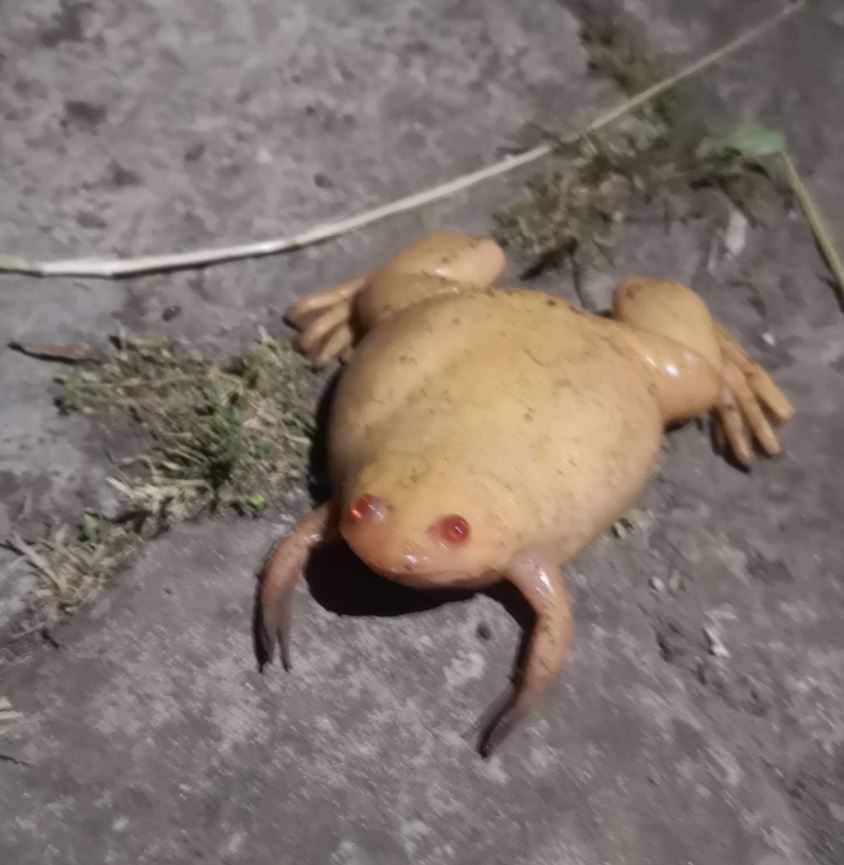
The Portsmouth Xenopus (above).
Please record any sightings of native or non-native frogs and toads at www.recordpool.org.uk.